
One of the most-heard remarks about being your own contractor is the problems you can have with subcontractors showing up or on time. So far this hasn't been a real issue because we were on a slow and flexible schedule. But when you need to make hay, do you think the sun would shine—NO.
We passed our inspection hurdles last week (Wed afternoon), so I called Dan (D&D insulation) and let him know we were ready to go on Thursday am. The key thing here is that we have to get the insulation inspected before the drywall goes on, so that starts to form a little chain of events. No inspections on Fridays.
Meanwhile, Frank the drywaller is hiring additional crew for our job (its been slow to date) and he'd also like to go shoot something to eat this fall (they call it hunting). He needs to schedule delivery of the drywall from Evergreen Products in Sequim. No big deal, but it can't be there when the insulators are working and you can't hang drywall if its not there.
To complicate matters a bit more, Richard Gifford the septic guy seems to have lost his phone. Last week he said he might be out on Sunday (Labor Day weekend) to finish the trench filling and regrading. Then someone might have mentioned the possibility of a long weekend, so that plan went up in smoke (no pun intended). Now its Thursday and two of my 3 current subs are AWOL, and the 3rd is chomping at the bit to get going.
On a positive note, the Ellis boys finished the soffit and are off the job with the exception of hanging the entry door between the garage and mudroom. I want to leave this off until all the big stuff is in the house, like appliances and furniture. I'm back up on the scaffolding hanging shingle nos. 4300-4500 this week on the gabled dormers. Having fun now.
The Wooden Boat Festival is this weekend, so I'm hoping for a little down time and boat gawking. I'll leave my checkbook at home.
Building a House in Kala Point, Port Townsend, WA
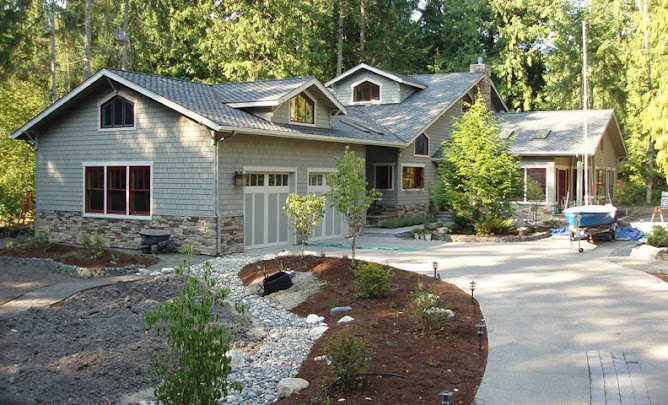
A running narrative of first-time builders of their retirement home in Port Townsend, WA (NE corner of the Olympic Pennisula, 60 miles NW of Seattle). Follow us as this adventure unfolds in late 2008 and beyond. 18 months under construction, we moved in on May 25th, 2010. Photo taken August 15, 2010.
Wednesday, September 9, 2009
Monday, September 7, 2009
Ellis boys to the rescue (Day 318)
 Troy and Gary Ellis came by as promised to help on the vexing soffit. I had installed about 100 ft of it, but had another 150 ft to go and it wasn't going to happen very fast. They showed up on Tuesday and worked most of the week, so the job should be finished next week (Tuesday). Gary cuts and Troy fits and nails. The soffit has two forms. 1) is the gable section, which consists of 2 ft tongue and groove cedar that butts directly into the house. This is pretty easy to lay up. The other form (2) runs parallel to the house and slopes upward. First you nail up a 3" wide board, then a 2" section of screen for air movement. This is followed by four tongue and groove boards, the last of which is a real bitch to fit into place. The gap has to be <1/4" wide or the shingles won't cover it. Then there are several places where the two soffit types collide at compound angles. Then add a half dozen corbels, one of which is 27 ft in the air and you have a recipe for disaster (on my part). I haven't seen the bill yet, but they worked 9 weeks on the house with a helper which netted out at about $5k per week. I suspect that's what it will take to finish the soffit, corbels, and a few other finish framing details.
 While all this was going on I busied myself with finishing the speaker layout, installing the hood fan (with Levi Ross), putting in the gutter drainage lines (4" pipe), adding blocking for toilet paper holders, wall mounted TVs, and hold bars in the showers. Oh yeah, I also spent 2 hours installing a fire stop in the chimney chase. If I had been about half my size and a contortionist it would have been a lot faster and easier, but I'm neither of those things.
This weekend and Labor Day will be spent cleaning out the house for the insulators and drywallers. The insulation should go in on Tues-Thursday and the drywall starting on Friday. I figure about 4-5 days to lay the drywall, and an equal amount of time to tape and mud it. Frank the Drywaller said we have 16,000 sq. ft of drywall, which equates to 333 sheets of 4'x12' drywall and about a mile (5,300 ft) of taping!

Monday, August 31, 2009
Inspector Clouseau (Day 311)
Tuesday is the grand inspection day. Inspector Clouseau and his colleagues will be here for two inspections. The first is for the low voltage systems in the house. This is done by the State out of Port Angeles. They will be looking at the central vacuum, digital TV (Direct TV-satellite), cable (TV, for future), phone, audio speakers, and internet wiring. I ran just under 1000 ft of 4 pair cable (cat 5e) for the internet and phone, about 500 ft of RG-2 for the TV systems, and about 200 ft of 2- and 4-strand CL2 wire for speakers. Also, Direct TV came by on Sunday (yes, this a a regular service day for them) and they installed the HD dish on the roof and attached 2 coils of double RG-2 cable, each 90 ft long. My job was to thread these four wires through the soffit, attic, down the crawl space, through the basement and into the media panel. Sounded like a daunting job (3x or worse), but I got that job done in about an hour (1 x; no I'm not looking for a job as an installer). Left to be done (today) is to staple up all the cable in the crawl space and attic. Nancy finished the basement and walls, but she draws the line at tall ladders and creepy spaces.
The second and bigger inspection is the final rough in, which is done by the County out of Port Townsend on Wednesday. They'll look at the framing, hold downs (42), fireplace and vents, air handling and vents, windows, exterior doors, and anything else that catches their eye. Left to be done is some fire blocking in the sauna walls, since I lowered the ceiling in this room to 7.5 ft rather than the standard 9 ft used throughout the house. Also, we need to drill a bunch of air holes in the rafters adjacent to skylights so that there is air flow from the skylights to the roof ridge crests.
This place ought to look like Grand Central Station by noon on Tuesday. Frank and Wayne (the masons) will be here working on the chimney chase. We have about 65 sq ft of rock to go up there, but they need to work off scaffolding rather than the inclined roof. So on Saturday, Darrell Olson (who helped me with the electrical conduit a couple weeks ago) and I built a platform on the roof for the masons. Its 4 ft x 12 ft, and about 2 ft above the roof next to the chimney. Darrell cut the sticks and I nailed them together on the roof, then we screwed a couple sheets of OSB to it. Its not a masterpiece, but it'll give the masons a stable platform to work from. Today I got a bunch of used carpet for the roof (traction issues) and stitched it together so it covers the tarp beneath the platform and around the top of the chimney. Then I put up the tar paper and stapled the wire mesh on the chase. It took most of the day, but there are other issues remaining for the inspection.
 Gary and Troy Ellis should be here on Tuesday also. They plan to put the soffit up on the higher areas that give me the willies. Plus they are fast and can do 5x as much as me. So if they get get the part of the soffit that runs parallel to the roof done, it'll save me a week and possible hospital visit. In addition, the insulation guys (D&D Insulation) will be here early on Tuesday to foam off all drill holes that go from one floor to another, which is a fire issue, an is an inspection issue.

And to add a bit of dust to the affair, Richard Gifford should be around with his purple backhoe filling some last holes and regrading the lot. Also he and is electrician need to finish pulling new cables for the septic pump, which they cut by accident last week after the mason ran over the clean out for the waste line. Don't even ask, this was the Pink Panther part of the job that thankfully was out of my hands (and wallet).
PS. Thursday. The big inspection went well. He said the framing job was really good and it was a very attractive house. He found four issues, all minor and we can deal with them today and get on with the insulating of the house. The masons never showed up (so my roof work was rushed for no good reason) due to a "family emergency", but the Ellis guys came over and dove into the soffit work. They are fast and good. Did as much on Wednesday as I could in a week! Richard, the septic guy, is missing in action. The first Chimacum High School football game is Friday and he is one of of the coaches--enough said.
The second and bigger inspection is the final rough in, which is done by the County out of Port Townsend on Wednesday. They'll look at the framing, hold downs (42), fireplace and vents, air handling and vents, windows, exterior doors, and anything else that catches their eye. Left to be done is some fire blocking in the sauna walls, since I lowered the ceiling in this room to 7.5 ft rather than the standard 9 ft used throughout the house. Also, we need to drill a bunch of air holes in the rafters adjacent to skylights so that there is air flow from the skylights to the roof ridge crests.
This place ought to look like Grand Central Station by noon on Tuesday. Frank and Wayne (the masons) will be here working on the chimney chase. We have about 65 sq ft of rock to go up there, but they need to work off scaffolding rather than the inclined roof. So on Saturday, Darrell Olson (who helped me with the electrical conduit a couple weeks ago) and I built a platform on the roof for the masons. Its 4 ft x 12 ft, and about 2 ft above the roof next to the chimney. Darrell cut the sticks and I nailed them together on the roof, then we screwed a couple sheets of OSB to it. Its not a masterpiece, but it'll give the masons a stable platform to work from. Today I got a bunch of used carpet for the roof (traction issues) and stitched it together so it covers the tarp beneath the platform and around the top of the chimney. Then I put up the tar paper and stapled the wire mesh on the chase. It took most of the day, but there are other issues remaining for the inspection.
 Gary and Troy Ellis should be here on Tuesday also. They plan to put the soffit up on the higher areas that give me the willies. Plus they are fast and can do 5x as much as me. So if they get get the part of the soffit that runs parallel to the roof done, it'll save me a week and possible hospital visit. In addition, the insulation guys (D&D Insulation) will be here early on Tuesday to foam off all drill holes that go from one floor to another, which is a fire issue, an is an inspection issue.
And to add a bit of dust to the affair, Richard Gifford should be around with his purple backhoe filling some last holes and regrading the lot. Also he and is electrician need to finish pulling new cables for the septic pump, which they cut by accident last week after the mason ran over the clean out for the waste line. Don't even ask, this was the Pink Panther part of the job that thankfully was out of my hands (and wallet).
PS. Thursday. The big inspection went well. He said the framing job was really good and it was a very attractive house. He found four issues, all minor and we can deal with them today and get on with the insulating of the house. The masons never showed up (so my roof work was rushed for no good reason) due to a "family emergency", but the Ellis guys came over and dove into the soffit work. They are fast and good. Did as much on Wednesday as I could in a week! Richard, the septic guy, is missing in action. The first Chimacum High School football game is Friday and he is one of of the coaches--enough said.
Friday, August 28, 2009
Passed 1st Electrical Inspection (Day 308)
On Thursday am, the electrical inspector (from Dept. of Labor and Industries, Port Angeles) was supposed to show up at noon. No worries, Gary Estes (electrician) and I had a half dozen things to complete while we waited for him. However, as we chatted about the remaining things to do, the inspector showed up 90 minutes early (I guess its not so busy anymore).
So off we went on the room to room inspection. He looked, asked questions, and found dozen things we'd missed. Gary fixed all his issues in a couple hours, but caught me on the low voltage part (speakers, cable, internet, etc). Apparently the speaker wire I purchased from Lowes was not rated for in the wall use, but luckily I hadn't gotten to this part of the low voltage wiring, which will be inspected next week just before insulation goes in. Also, Levi Ross had forgotten to pull a permit for the low voltage (thermostats) part of the radiant heating, so Levi will have to apply for this online over the weekend. Then we'll call for the low voltage inspection, probably on Tuesday next.
All in all, it went pretty well. Gary said that the things the inspector found were pretty typical, and if we'd had time to do our last little bit there would have only been a couple of issues. Nevertheless, the inspector put the magic "Approved" label on the meter box, and we're ready to have Puget Sound bring the voltage from the street to the house. I called them and they said it would take 3-5 working days to get the order executed (not the best use of terms, huh). So by Sept. 1, their installation subcontractor will be on site to pull a big nasty cable through the conduit that Darrell Olson and I laid a couple of weeks ago.
While all this was going on, Richard Gifford returned with his little backhoe and filled the trenches and regraded the front of the lot. Our environmental site plan for runoff indicated we'd need 3 dry wells for the roof runoff. Dry wells are pits filled with gravel and landscape fabric, the idea being that they will serve as points for recharge on the lot, rather than having the runoff go to the street and into a culvert or a local stream. This is exactly the opposite of Colorado, where they don't allow you to capture (and use) runoff. The bottom line is that western Washington has plenty of agua, and eastern Colorado doesn't.
But I digress. Richard suggested using an alternate technology for the dry wells. It seems that someone makes 10 ft long mesh bags that have a perforated pipe in the middle, and about 12" of foam peanuts around the pipe. The peanuts act like gravel and allow lots of porosity in the infiltration bag. I couldn't have been easier. Richard connected three bags (screw couplings) threw then in the water pipe trench, connected my drain pipe to this snake-like contraption and buried it all. I expected to see Elmo and the Sesame Street gang show up. No gravel or trucking involved (less $$), and all done in 30 minutes. The dry well in the back yard will have to wait until the power is pulled and this part of the trench is filled. So I'm back onto the low voltage and building some scaffolding on the roof for the masons to use on the chimney. That starts Monday, insulation starts Tuesday, and drywall show start a week from now±. The joint is jumping, for a change.
So off we went on the room to room inspection. He looked, asked questions, and found dozen things we'd missed. Gary fixed all his issues in a couple hours, but caught me on the low voltage part (speakers, cable, internet, etc). Apparently the speaker wire I purchased from Lowes was not rated for in the wall use, but luckily I hadn't gotten to this part of the low voltage wiring, which will be inspected next week just before insulation goes in. Also, Levi Ross had forgotten to pull a permit for the low voltage (thermostats) part of the radiant heating, so Levi will have to apply for this online over the weekend. Then we'll call for the low voltage inspection, probably on Tuesday next.
All in all, it went pretty well. Gary said that the things the inspector found were pretty typical, and if we'd had time to do our last little bit there would have only been a couple of issues. Nevertheless, the inspector put the magic "Approved" label on the meter box, and we're ready to have Puget Sound bring the voltage from the street to the house. I called them and they said it would take 3-5 working days to get the order executed (not the best use of terms, huh). So by Sept. 1, their installation subcontractor will be on site to pull a big nasty cable through the conduit that Darrell Olson and I laid a couple of weeks ago.
While all this was going on, Richard Gifford returned with his little backhoe and filled the trenches and regraded the front of the lot. Our environmental site plan for runoff indicated we'd need 3 dry wells for the roof runoff. Dry wells are pits filled with gravel and landscape fabric, the idea being that they will serve as points for recharge on the lot, rather than having the runoff go to the street and into a culvert or a local stream. This is exactly the opposite of Colorado, where they don't allow you to capture (and use) runoff. The bottom line is that western Washington has plenty of agua, and eastern Colorado doesn't.
But I digress. Richard suggested using an alternate technology for the dry wells. It seems that someone makes 10 ft long mesh bags that have a perforated pipe in the middle, and about 12" of foam peanuts around the pipe. The peanuts act like gravel and allow lots of porosity in the infiltration bag. I couldn't have been easier. Richard connected three bags (screw couplings) threw then in the water pipe trench, connected my drain pipe to this snake-like contraption and buried it all. I expected to see Elmo and the Sesame Street gang show up. No gravel or trucking involved (less $$), and all done in 30 minutes. The dry well in the back yard will have to wait until the power is pulled and this part of the trench is filled. So I'm back onto the low voltage and building some scaffolding on the roof for the masons to use on the chimney. That starts Monday, insulation starts Tuesday, and drywall show start a week from now±. The joint is jumping, for a change.
Tuesday, August 25, 2009
The Water Flowith (Day 305)
We've been working on getting H2O to the house this past two weeks. Called the Kala Point Water Company, which is a private entity, and arranged for Eric Thomas (the owner) to come out and install a meter and hookup. Nothing happened for a week, then he showed up and sized up the job. He wasn't prepared for 1 1/4" pipe (my end), which he recommended I use, so he didn't have the right size fittings. Off to Hadlock Building Supply. Then there was a couple day lapse, due to a summer cold. So on Sunday, up comes Eric (over the cold, mostly) to install the meter and hookup. All was well, except the old meter box had been deformed by the adjacent Alder tree, so he'd need to get a new one.
Eric is a very likable guy; owns 4 small water companies in the area, all targeted for subdivisions such as our own. I discussed the water business with him, and it appears to be quite lucrative if you buy the right companies. Watch out for steel or lead pipes (PVC is best), get good tanks, and install UV treatment for iron and manganese components. Anyway, he'd brought his family over from Sequim to the Kala Point Pool (kids and wife), so he only had a couple hours to finish off my job. So I have water, lots of it, at about 50-60 psi (new pump at tanks). Bob Brown came out on Wednesday and made the connection to the house, so we are all done, except for installing the valves for the three showers and tub, all of were shipped to Fergusons in Sequim on Monday and picked up by my lovely bride of 37 years.
Nail Plate Nancy, we'll call her. Her assignment these past few days has been to nail 1.5 x 3" steel plates over any shallow electrical or plumbing parts. The logic is that if its less then 1.5" from the surface, the drywall guys could penetrate something important with a nail or screw, hence the steel plate. Well, when we were done, I think we had about 150 nail plates on studs and joists—all cheap insurance for a potential problem, like I had on Sunday.
I needed to move a drain pipe the basement ceiling that conflicted with the soon to be installed dryer vent. You wouldn't believe all the competing systems in a house: fresh water, gray water, 120v electric, low voltage, central vacuum, and vents. So I chopped out a section of drain vent, put in some 45° bends, and made space for the vertical drop for the dryer vent. No worries, right. Then I needed to move the drain support (metal strap), so I unscrewed the screw and water erupted like Vesuvius. It came squirting down at 50 psi (the system was under pressure from testing) and about 10 gallons spilled out on the basement floor before I got all the valves turned off. It seems like the plumber (me) made a fundamental error and screwed the support strap to the subfloor (Warmboard) and managed to penetrate a Pex tube. All was well until I unscrewed the screw from the Pex and opened up the hole. Actually it was a good thing because 5 or 10 years down the road that screw would have rusted and allowed the Pex to drip, drip, drip into the hardwood and cork flooring, so of like a festering canker sore.
I sawed out the stud plate, exposed the punctured Pex, and chopped it out. In about an hour, I'd made the repair, replaced the plate, and all was well. So I learned a valuable lesson. Don't screw up (vertically) and you can't hit a Pex tube.
Our electrical rough in inspection is scheduled for Thursday (Aug. 27th), so if we pass we have the Go card for our big county inspection, which involved framing, hold downs, shear walls, etc. Once this is done (end of August), we're on to insulation and drywall, both of which will be hired out. This will be a major advance for the house. Once drywall is in, we are officially in the "Finishing Stages" of the house (paint, tile, wood floors, and cabinets). If you are handy at such things, the Hotel Machette is open for business.
Eric is a very likable guy; owns 4 small water companies in the area, all targeted for subdivisions such as our own. I discussed the water business with him, and it appears to be quite lucrative if you buy the right companies. Watch out for steel or lead pipes (PVC is best), get good tanks, and install UV treatment for iron and manganese components. Anyway, he'd brought his family over from Sequim to the Kala Point Pool (kids and wife), so he only had a couple hours to finish off my job. So I have water, lots of it, at about 50-60 psi (new pump at tanks). Bob Brown came out on Wednesday and made the connection to the house, so we are all done, except for installing the valves for the three showers and tub, all of were shipped to Fergusons in Sequim on Monday and picked up by my lovely bride of 37 years.
Nail Plate Nancy, we'll call her. Her assignment these past few days has been to nail 1.5 x 3" steel plates over any shallow electrical or plumbing parts. The logic is that if its less then 1.5" from the surface, the drywall guys could penetrate something important with a nail or screw, hence the steel plate. Well, when we were done, I think we had about 150 nail plates on studs and joists—all cheap insurance for a potential problem, like I had on Sunday.
I needed to move a drain pipe the basement ceiling that conflicted with the soon to be installed dryer vent. You wouldn't believe all the competing systems in a house: fresh water, gray water, 120v electric, low voltage, central vacuum, and vents. So I chopped out a section of drain vent, put in some 45° bends, and made space for the vertical drop for the dryer vent. No worries, right. Then I needed to move the drain support (metal strap), so I unscrewed the screw and water erupted like Vesuvius. It came squirting down at 50 psi (the system was under pressure from testing) and about 10 gallons spilled out on the basement floor before I got all the valves turned off. It seems like the plumber (me) made a fundamental error and screwed the support strap to the subfloor (Warmboard) and managed to penetrate a Pex tube. All was well until I unscrewed the screw from the Pex and opened up the hole. Actually it was a good thing because 5 or 10 years down the road that screw would have rusted and allowed the Pex to drip, drip, drip into the hardwood and cork flooring, so of like a festering canker sore.
I sawed out the stud plate, exposed the punctured Pex, and chopped it out. In about an hour, I'd made the repair, replaced the plate, and all was well. So I learned a valuable lesson. Don't screw up (vertically) and you can't hit a Pex tube.
Our electrical rough in inspection is scheduled for Thursday (Aug. 27th), so if we pass we have the Go card for our big county inspection, which involved framing, hold downs, shear walls, etc. Once this is done (end of August), we're on to insulation and drywall, both of which will be hired out. This will be a major advance for the house. Once drywall is in, we are officially in the "Finishing Stages" of the house (paint, tile, wood floors, and cabinets). If you are handy at such things, the Hotel Machette is open for business.
Thursday, August 20, 2009
Drill Baby, Drill (Day 301)
A couple of weeks ago the county denied our request for a variance on the water pipe location (see previous blog). So that meant a different route (OK), but no way to enter the house, as in a punch out in the foundation. The obvious remedy was to drill through the foundation. So for a geologist this is no big deal. We drill stuff all the time. Rock cores for strength testing, cores for paleomagnetism, sediment cores for paleoclimate, anon, anon. Just rent a drill and punch out a couple of holes.
Well its a 8" concrete foundation riddled with rebar, thanks to our old friend Mikael (structural engineer). You know I'd find a place to drill through rebar and I did, but not until the second hole. Yes, second hole, because the first hole was into the crawl space and the second hole was from the crawl space to basement, where the Pex piping was stubbed out by the plumber.
Hadlock (Just Ask) Rental had their drill out on long-term rental so I went to A+ Rental down the highway. Sort of a rag tag operation, but they had a real man's drill and bit. 1/2 HP drill and 2" diamond bit was the ticket. Hook up the garden house for water cooling, pull it in, and let her spin. Had visions of Sarah Pallin standing behind me encouraging me to Drill it Baby. So I did. Took about 15 minutes to punch through, not bad. Then I moved the hose and power to the crawl space and started no. 2. All went well until I met "Uncle Rebar". Drill overheated, blew the entire circuit breaker and called for a time out. Two minutes later, I was back at it. This happened 3 or 4 times, but in about a half hour I broke through to the basement. Mission accomplished, and now I can see Russia from the second floor, just like Ms Pallin.
Progress was made on other fronts today. The cable guy (hard-wire internet) came buy and dropped off 200 ft of RG11 coax cable, which goes underground (with the H2O) from a street side junction box to the main electrical circuit panel. Qwest also dropped phone cable in my trench. So all the buried services (electrical, water, cable, phone) are in the ground and we're ready to push dirt around again. A little rain would help, but I'm not getting greedy.
Well its a 8" concrete foundation riddled with rebar, thanks to our old friend Mikael (structural engineer). You know I'd find a place to drill through rebar and I did, but not until the second hole. Yes, second hole, because the first hole was into the crawl space and the second hole was from the crawl space to basement, where the Pex piping was stubbed out by the plumber.
Hadlock (Just Ask) Rental had their drill out on long-term rental so I went to A+ Rental down the highway. Sort of a rag tag operation, but they had a real man's drill and bit. 1/2 HP drill and 2" diamond bit was the ticket. Hook up the garden house for water cooling, pull it in, and let her spin. Had visions of Sarah Pallin standing behind me encouraging me to Drill it Baby. So I did. Took about 15 minutes to punch through, not bad. Then I moved the hose and power to the crawl space and started no. 2. All went well until I met "Uncle Rebar". Drill overheated, blew the entire circuit breaker and called for a time out. Two minutes later, I was back at it. This happened 3 or 4 times, but in about a half hour I broke through to the basement. Mission accomplished, and now I can see Russia from the second floor, just like Ms Pallin.
Progress was made on other fronts today. The cable guy (hard-wire internet) came buy and dropped off 200 ft of RG11 coax cable, which goes underground (with the H2O) from a street side junction box to the main electrical circuit panel. Qwest also dropped phone cable in my trench. So all the buried services (electrical, water, cable, phone) are in the ground and we're ready to push dirt around again. A little rain would help, but I'm not getting greedy.
Tuesday, August 18, 2009
Let there be Light (Day 299)
We've been lured into the recessed can game, which is OK in terms of dollar value but they create a bit of an institutional/sterile look. However, the alternative is beyond our fiscal grasp. Let me give you an example. We put five Juno 6" recessed cans in the ceiling of the living room. Three in front of the fireplace and two off to the side. Net cost was about $40, plus another $100 for the trim rings. They sort of have a computer printer deal going there. The all metal, hefty, complicated and electrified can (i.e., printer) is cheap and the little plastic fufu trim rings (i.e., printer cartridge) is expensive. Can't have the ring without the can or the printer without the cartridge. Oh yeah, did I mention that the recessed can for the sloping roofs (bedroom, sun room, and kitchen) go for $40 instead of $8. Seems that anything out of the ordinary goes for way more (5x). I'm definitively in the wrong business.
The alternative to cans is scary. Hanging light fixtures, good stylish ones, are in the $400 to $1000 (or more) range, and you'd need one per room if you didn't use cans. Also, you'd need sconces (not scones, which are way more palatable) for some halls, distant walls, or stairs. These puppies go for $50 (trashy) to $300. So to make life manageable we settled on about 60 recessed cans, 2 hanging fixtures (dining room and kitchen) and about 12 sconces (4 for stairs, 6 for bath vanities, a couple others), and a couple fans. Add to that exterior lights, which are similarly priced. We bought 1 hanging light for the main porch, 5 sconces for the other porches, and 2 sconces for the sides of the garage. When I made a list of all the fixtures to track them, we had 104 light fixtures.
I can see the Bonneville Power Administration smiling already. I think I'll get one of those neon light versions of READY WATT, the electric mascot, and put it on the front of the garage. Heck, if we just put colored bulbs in the lamps, we'll be ready for Christmas.
Now the real down side. I have to wire 104 light fixtures. The electrican that helped finish the wiring when I said "Uncle" suggested I do this manual labor and save $70/hr. Good Idea. I did 30 recessed cans today, and I''ll polish the remainder off tomorrow. The sconces and hanging fixtures get wired after drywall or exterior painting, so I may be able to finish the true electrical work tomorrow. Then its a couple days of planning, pulling and wiring the phone, speaker, TV, and computer networks, mostly with Cat5e wire, which is an fancy name for expensive, heavy duty 4 pair stranded wire. At that point Gary (electrican) comes back, gives us the once over and orders the electrical inspection by the Dept. of Labor and Industries, a WA state agency. This is the only inspection that the County doesn't conduct. I think this arrangement was made to protect the electrical labor unions, and to justify a state-wide electrical code, which is a good idea. Some counties barely have a building code, and electrical problems are the one issue that can be life threatening (i.e., FIRE).
The alternative to cans is scary. Hanging light fixtures, good stylish ones, are in the $400 to $1000 (or more) range, and you'd need one per room if you didn't use cans. Also, you'd need sconces (not scones, which are way more palatable) for some halls, distant walls, or stairs. These puppies go for $50 (trashy) to $300. So to make life manageable we settled on about 60 recessed cans, 2 hanging fixtures (dining room and kitchen) and about 12 sconces (4 for stairs, 6 for bath vanities, a couple others), and a couple fans. Add to that exterior lights, which are similarly priced. We bought 1 hanging light for the main porch, 5 sconces for the other porches, and 2 sconces for the sides of the garage. When I made a list of all the fixtures to track them, we had 104 light fixtures.
I can see the Bonneville Power Administration smiling already. I think I'll get one of those neon light versions of READY WATT, the electric mascot, and put it on the front of the garage. Heck, if we just put colored bulbs in the lamps, we'll be ready for Christmas.
Now the real down side. I have to wire 104 light fixtures. The electrican that helped finish the wiring when I said "Uncle" suggested I do this manual labor and save $70/hr. Good Idea. I did 30 recessed cans today, and I''ll polish the remainder off tomorrow. The sconces and hanging fixtures get wired after drywall or exterior painting, so I may be able to finish the true electrical work tomorrow. Then its a couple days of planning, pulling and wiring the phone, speaker, TV, and computer networks, mostly with Cat5e wire, which is an fancy name for expensive, heavy duty 4 pair stranded wire. At that point Gary (electrican) comes back, gives us the once over and orders the electrical inspection by the Dept. of Labor and Industries, a WA state agency. This is the only inspection that the County doesn't conduct. I think this arrangement was made to protect the electrical labor unions, and to justify a state-wide electrical code, which is a good idea. Some counties barely have a building code, and electrical problems are the one issue that can be life threatening (i.e., FIRE).
Saturday, August 15, 2009
All Decked Out (Day 296)
 As part of the exterior package, we have two small patio decks and two porches that needed to be finished off. Jim Quandt, a sailing/drinking/cooking friend, retired from Weyerhaeuser a couple years ago and moved up to Kala Point with his wife Char. We met them right off at TGIF and became friends quickly. Over the winter, Jim started a little carpentry/house repair business called Jim's Tool Time (think Tim Allen here) to keep him busy and fund his sailing/travel bug. He helped us previously by building 2 dozen corbels (braces) for the house, so when the deck issue surfaced, I gave him a call.
 When it comes to decking now days, you have lots of choices. However, unless you're made of money and have a landscaper/repairman, you need to use a composite wood product. Lots of them out there, but Trex is probably the best and most popular (http://www.trex.com/). Its weather proof, comes in several colors and textures, and will out last wood by leaps and bounds. Wood needs to be power washed and treated every several years, and good wood (like Brazilian hardwoods) is expensive. So we picked out some Trex decking (Winchester Gray Trex from Carl's), ordered it, and hired Jim to finish this part of the house off.
I was his assistant and had put all the support framing in place for the job. We started on Wednesday, and by Saturday morning, we had it all finished. We used 19 pieces of 20 ft Trex ($1026; 1.1" by 5.5") and 6 pieces of trim board ($275; 3/4" x 7.25"), and two boxes of square drive screws ($102).
 The cost of decking came out to be about $1400 for 150 square feet, which nets out at $9.33/sq. ft. This doesn't count the 2x6 and 4x4 pressure-treated lumber, hardware, and cement blocks I used for the framing and supports (probably a couple 100 bucks there). Labor is typically equal to materials, so if you hired it all out the cost would be $20/sq. ft or 3 big ones for the project. So we saved a bit by using Jim and my labor; the job looks professionally done (of course), and its one more thing off our list.
 He's off to the County fair and sailing, and we're off to a short vacation. I promised Nancy an overseas cruise to a foreign country (i.e., Victoria, BC). We'll spend some loonies, eat some good food, and see some fancy plants and trees at Buchart Gardens (research for our winter landscaping projects). Interestingly, I was drug through there by my parents 45 years ago (1964 Seattle Worlds Fair trip). Now we're going on our own and actually looking forward to it. Who ever said you become your parents was right.
Friday, August 14, 2009
TBTB (Day 295)
TBTB. Too busy to blog. Swear to god, I'm multitasking bigtime and feeling like I have ADHD. Electrical, decks, water pipe, electrical conduit, bathroom cabinet layout, flooring, light fixtures, backfilling by shovel, plus trying to supervise a couple paid workers. Decisions that have to be made today or pretty damn soon. Can't wait for a day when I only have one task and goal. More later, but less bitching I hope. Michael
Wednesday, August 12, 2009
37 years ago today (Day 293)
 August 12, 1972. Michael Ney Machette and Nancy Geraldine Hart were married in the Portola Valley Presbyterian Church. After a reception at the home of Mr. and Mrs. William Hart, the newlywed couple spent their wedding night at the Stanford Arms Hotel in San Francisco in route to a honeymoon at Lake Tahoe, California. On August 22, Michael and Nancy packed their VW bus (Minerva) with all their worldly goods and departed for Denver, Colorado, where Michael will attend graduate school in Geology at the University of Colorado and Nancy will start her career in merchandising (Denver Dry Goods).
 August 12, 2009. Michael and Nancy, married 37 years today, will celebrate the event in a low key manner. Nancy is researching bathroom fixtures and cabinets, whereas Michael is working on decks, electrical, water piping, and other chores at the new house. They plan to have dinner with neighbors (aka, Soup Night at the Poseys), and visit Victoria, BC, this weekend for a more formal celebration.
On August 17, 2009 they will have been in Port Townsend for exactly one year (oh yeah).
Sunday, August 9, 2009
Full Flush Mode (Day 290)
Last Friday we had a performance of the Bellagio fountains, as they call it. Didn't even have to go to Vegas. Susan Miller, the septic system designer, came over and set up the pump test for the septic system. Richard Gifford had finished the tanks and piping installation, I mounted the controller boxes at the rear of the house and ran conduit to the pump tank, and Gary Estes (electrician) wired the boxes for a temporary run (i.e., via extension cord). The control box has a Palm Pilot interface which allows the septic designer (or other certified technician) to set up pump times and intervals. So with a wave of the magic wand, Susan turned on the pump and we had 5 lines of fountains going about 10 ft into the air. While they are spurting, she turned the control valves on each line to balance the flow in the system, otherwise the short lines (30 ft) would have higher pressure (and fountains) than the long lines (50-60 ft). Once the balancing act was finished and the pump ran a few cycles, she shut the puppy down, approved the installation for the County, and now we're set to do the back filling.
The gravel beds that get injected with effluent (the 50 cent word for drain field water) are covered with a filter fabric (landscape fabric, I think) then covered with about 12" of fill. On top of this goes about 6" of top soil, something we'll have to have delivered from a local source. Most sand and gravel operators create "top soil" by mixing sand, compost and peat together, which is much better than the silty sand and gravel that comes from the subsurface, but not nearly as good as the 6-12 A horizon that was on the lot before we scraped it all away. Almost everything in Kala Point and the Quimper Peninsula is Vashion lodgement till (glacial deposits), which was deposited about 20,000 years ago as glaciers marched south towards Tacoma. The till was overridden by 3000 ft of ice and has become fairly compact, hence the poor percolation and necessity for a pressure system rather than a simple (and cheaper) gravity septic system.
By Monday afternoon Richard had the septic field covered and then dig new trenches for the combined electrical conduit and water line. We got a rude awaking last week when the county refused our request to have a crossing of the water and sewer lines. In their eyes this is a mortal sin. The logic goes as follows (please have a stiff drink to keep up here). During a big earthquake, ground settlement may allow crossing lines to break and mix waters, such that fresh water going to the house will be polluted with effluent. Sound pretty reasonable, right? Except, during a big earthquake 1) the Kala Point water tanks would have gone south, 2) there is no reason to have differential settlement at the proposed line crossing (remember we are underlain by hundreds of feet of compact till), and 3) the house would likely be on fire and polluted water is our last concern. Nevertheless, they disallowed our request for a waiver on the crossing and so how we need to dig a trench across the front of the lot, down the north edge, then enter the house in the crawl space. I need to rent a coring drill (2") and drill through the 8" foundation in two places, then have Bob Brown come back and tie the outside and inside water lines together. Pain in the ass.
The only good thing to come out of this is that we had a spare hole in the foundation that we ran a 3/4" Pex line out of. This will be a stub in for eventual watering control box to do drip or sprinklers. Need to think about the future and the Pacific Northwest as a semiarid landscape.
By code the electric supply line has to be in 3" PVC conduit. OK, its expensive, heavy and doesn't bend much. So on Tuesday I laid 16 10-ft sections of conduit in trench and one 45° bend, put a pull rope through them all, then glued it all together. Darell Olson, a Montana transplant who lives down the street, helped me and we got the conduit installed in 2 hours! Puget Sound Energy (PSE) wants the conduit to come to about 4 ft of the transformer and 4 ft from the service entry on the rear of the house, so we have dig a bit wider at the ends. I was surprised to have them not connect the conduit, but the logic is that in case they have to install new wiring to the house, they can dig down at the ends and uncover the unsheilded wire. Then they connect new wire to the old wire, and pull it through the conduit (i.e., raceway). Seems to make sense to me, and its less work than connecting the conduit at the ends.
After the electrical is completed, I'll lay the water supply pipe (i.e. main line) adjacent to but at least 18" away from the conduit. We'll use 1.25", 160 psi Poly Pipe for this, similar to what is used for sprinkler systems but heavier gauge (PolyPipe is a pressure-rated High Density polyethylene pipe). It comes in 100 ft and 300 ft rolls, so we're going for the long one so there are no buried connections. It was out of stock locally, but Hadlock Building Supply ordered it for delivery on Wednesday (8/12). The water pipe is just a roll out in the trench (>18" from electrical), with the Water Company connecting the upstream side, and Bob Brown (plumber) connecting the house side with a shut off valve. All is well in the tubing world.
The gravel beds that get injected with effluent (the 50 cent word for drain field water) are covered with a filter fabric (landscape fabric, I think) then covered with about 12" of fill. On top of this goes about 6" of top soil, something we'll have to have delivered from a local source. Most sand and gravel operators create "top soil" by mixing sand, compost and peat together, which is much better than the silty sand and gravel that comes from the subsurface, but not nearly as good as the 6-12 A horizon that was on the lot before we scraped it all away. Almost everything in Kala Point and the Quimper Peninsula is Vashion lodgement till (glacial deposits), which was deposited about 20,000 years ago as glaciers marched south towards Tacoma. The till was overridden by 3000 ft of ice and has become fairly compact, hence the poor percolation and necessity for a pressure system rather than a simple (and cheaper) gravity septic system.
By Monday afternoon Richard had the septic field covered and then dig new trenches for the combined electrical conduit and water line. We got a rude awaking last week when the county refused our request to have a crossing of the water and sewer lines. In their eyes this is a mortal sin. The logic goes as follows (please have a stiff drink to keep up here). During a big earthquake, ground settlement may allow crossing lines to break and mix waters, such that fresh water going to the house will be polluted with effluent. Sound pretty reasonable, right? Except, during a big earthquake 1) the Kala Point water tanks would have gone south, 2) there is no reason to have differential settlement at the proposed line crossing (remember we are underlain by hundreds of feet of compact till), and 3) the house would likely be on fire and polluted water is our last concern. Nevertheless, they disallowed our request for a waiver on the crossing and so how we need to dig a trench across the front of the lot, down the north edge, then enter the house in the crawl space. I need to rent a coring drill (2") and drill through the 8" foundation in two places, then have Bob Brown come back and tie the outside and inside water lines together. Pain in the ass.
The only good thing to come out of this is that we had a spare hole in the foundation that we ran a 3/4" Pex line out of. This will be a stub in for eventual watering control box to do drip or sprinklers. Need to think about the future and the Pacific Northwest as a semiarid landscape.
By code the electric supply line has to be in 3" PVC conduit. OK, its expensive, heavy and doesn't bend much. So on Tuesday I laid 16 10-ft sections of conduit in trench and one 45° bend, put a pull rope through them all, then glued it all together. Darell Olson, a Montana transplant who lives down the street, helped me and we got the conduit installed in 2 hours! Puget Sound Energy (PSE) wants the conduit to come to about 4 ft of the transformer and 4 ft from the service entry on the rear of the house, so we have dig a bit wider at the ends. I was surprised to have them not connect the conduit, but the logic is that in case they have to install new wiring to the house, they can dig down at the ends and uncover the unsheilded wire. Then they connect new wire to the old wire, and pull it through the conduit (i.e., raceway). Seems to make sense to me, and its less work than connecting the conduit at the ends.
After the electrical is completed, I'll lay the water supply pipe (i.e. main line) adjacent to but at least 18" away from the conduit. We'll use 1.25", 160 psi Poly Pipe for this, similar to what is used for sprinkler systems but heavier gauge (PolyPipe is a pressure-rated High Density polyethylene pipe). It comes in 100 ft and 300 ft rolls, so we're going for the long one so there are no buried connections. It was out of stock locally, but Hadlock Building Supply ordered it for delivery on Wednesday (8/12). The water pipe is just a roll out in the trench (>18" from electrical), with the Water Company connecting the upstream side, and Bob Brown (plumber) connecting the house side with a shut off valve. All is well in the tubing world.
Thursday, August 6, 2009
Get Out of Jail Free Card (Day 287)
It feels like we're playing Monopoly out here. We met with the Architectural (standards) Committee yesterday and presented our case for an extension to the completion date for the exterior of the house. I've harangued about this before, so no reason to replow that ground. All in all, it went smoothly. The one thing that made our case palatable to the committed was presenting a report card of what we'd done the past two months, what was left to do, how and who was going to do it, and when. The bottom line was it will take about 2 more months to finish all of the exterior (some things must wait for others, like the driveway after drywall trucks). We also submitted our landscape plan, which was finalized after we placed all the septic tanks, lines and propane tank.
Attached is the contents of our letter, if you care to see our strategy and logic. Now we have to deliver on our promises.
More later, The Completers.
To: Kala Point Architectural Committee
Ron Kubec, Chairman
David Harrah, Representative
From: Michael and Nancy Machette
Subject: Status of Building Project
120 Fairbreeze Drive, Kala Point
Since receiving notice from the Committee in early June, we have concentrated on completing the exterior of our house. The following items have been completed or are near final. As you can see, we should be able to complete the exterior by late September by hiring out the bulk of the remaining work.
Garage doors: Installed and operative. Primed, but need to be painted to match house. Anticipated finish, early Sept.
Septic system: Tanks and main line installed. Drain field gravel and piping installed. Pump and controller installed. Will do pump test this week, then awaiting County and L&I inspections.
Anticipated finish, August 13th.
Electric and water service: Service main (conduit) will be installed in trench, along with water service by mid August. Having trouble contacting Eric Thomas for water meter hookup, but will try to finalize ASAP.
Landscape grading. Will be completed after back filling septic lines. drain field, and electric/water lines. Hired out, anticipated finish, August 21.
Single siding: Installed on most of street side of house. About 50% complete. Anticipated finish, mid Sept. (This is a slow process owing to hand dipping a large number of shingles. Homeowner installation.)
Hardiboard siding: Completed on north and rear of house, needs trim detail. About 95% complete. Anticipated finish, mid August.
Soffit: Installed on most of street side of house. About 50% complete. Need help for high roof line, will hire out starting August 8th. Anticipated finish, early Sept.
Rock facing (belt line around house). Completed August 1. Will add rock facing to chimney, but mason can’t start until late August. (All cement mixing and prep will be done at rear of house. Anticipated finish, mid Sept.
Port-A-Potty: Will move inside garage as soon as drywall is hung. As an interim measure, we can move it to the rear of the house, of out sight from the road.
Decks: Need to build stair jacks, then install decking. Hired out, to start August 10th. Anticipated finish, late August.
Driveway : Received variance from County to use standard concrete, rather than a perivous surface (gravel, porous concrete or open pavers). Will not install until drywall is loaded into garage and house (excessive weight of trucks). Concrete needs 28 days to obtain full strength. Anticipated completion, late Sept. (earlier if possible).
Landscape plan: Prepared and to be submitted at Aug. 5th meeting.
Attached is the contents of our letter, if you care to see our strategy and logic. Now we have to deliver on our promises.
More later, The Completers.
August 5, 2009
To: Kala Point Architectural Committee
Ron Kubec, Chairman
David Harrah, Representative
From: Michael and Nancy Machette
Subject: Status of Building Project
120 Fairbreeze Drive, Kala Point
Since receiving notice from the Committee in early June, we have concentrated on completing the exterior of our house. The following items have been completed or are near final. As you can see, we should be able to complete the exterior by late September by hiring out the bulk of the remaining work.
Garage doors: Installed and operative. Primed, but need to be painted to match house. Anticipated finish, early Sept.
Septic system: Tanks and main line installed. Drain field gravel and piping installed. Pump and controller installed. Will do pump test this week, then awaiting County and L&I inspections.
Anticipated finish, August 13th.
Electric and water service: Service main (conduit) will be installed in trench, along with water service by mid August. Having trouble contacting Eric Thomas for water meter hookup, but will try to finalize ASAP.
Landscape grading. Will be completed after back filling septic lines. drain field, and electric/water lines. Hired out, anticipated finish, August 21.
Single siding: Installed on most of street side of house. About 50% complete. Anticipated finish, mid Sept. (This is a slow process owing to hand dipping a large number of shingles. Homeowner installation.)
Hardiboard siding: Completed on north and rear of house, needs trim detail. About 95% complete. Anticipated finish, mid August.
Soffit: Installed on most of street side of house. About 50% complete. Need help for high roof line, will hire out starting August 8th. Anticipated finish, early Sept.
Rock facing (belt line around house). Completed August 1. Will add rock facing to chimney, but mason can’t start until late August. (All cement mixing and prep will be done at rear of house. Anticipated finish, mid Sept.
Port-A-Potty: Will move inside garage as soon as drywall is hung. As an interim measure, we can move it to the rear of the house, of out sight from the road.
Decks: Need to build stair jacks, then install decking. Hired out, to start August 10th. Anticipated finish, late August.
Driveway : Received variance from County to use standard concrete, rather than a perivous surface (gravel, porous concrete or open pavers). Will not install until drywall is loaded into garage and house (excessive weight of trucks). Concrete needs 28 days to obtain full strength. Anticipated completion, late Sept. (earlier if possible).
Landscape plan: Prepared and to be submitted at Aug. 5th meeting.
Wednesday, August 5, 2009
Holding Pressure (Day 286)
Bob Brown, Dr. of Drips (aka our plumber), came over with his son Josh to check out my plumbing, fix a few things, build out the copper part of the system, and install the incoming water main. The water main will have to wait a bit, at least until KP Water installs our meter and Richard Gifford digs the service trench for the water and electricity (next week, hopefully).
The verdict was Michael got a B on the ABS (drains) and an A on the Pex water supply piping. For the ABS, I had forgot to glue 3 fittings and put a screw through a 4th. Conversely, they installed the washer control box and screwed up the drain line by not letting the glue dry long enough before testing. To test the ABS drain line, you put cookies (temporary plugs, not Oreos) in the open pipes and fill the entire piping with water. If nothing leaks, you're good to go (to the crapper). So we found a few leaks, drained and fixed them; refilled, found the last leak, drained fixed, and filled; and refilled for the final time. The inspector will come and check it out on Thursday. Takes about 50 gallons to fill all the drain pipes in the house, so we should be good to have some really big parties there.
For the Pex water supply lines, I only had one bad fitting. That was on the manifold that distributes hot water to the master bath room. It divides a 3/4 inch line into four 1/2 lines (shower, two sinks, and toilet). Didn't get the fittings up snug, so off it came and they rebuilt in in about 5 minutes (vs the 30 minutes for my original effort). To test the water supply, they attached my neighbor's (Jan and Carol Orme) hose to the washer supply line and filled it all up. Then they topped it off with 60 psi of air pressure. This morning it still had 60 psi, so the inspector will check this part out along with the ABS drains.
What I've come to realize is that professional plumbers (and others) operate at light speed compared to me and other home owner/builders. They know the codes (so don't have to redo mistakes), have a bag of tricks for making things easier, and they don't sweat the small stuff. Also, having all the tools and supplies on hand (usually in vans or trucks) means no trips back to the shop or plumbing stores.
This last go around with Dr. Brown cost me about 20 hours of time (2 guys at 10 hours). Going rate is about $70/hr, or $1400 and another $600 in supplies and tax (on labor too). So for $2000, they moved our stalled out plumbing project to completion (rough in) and removed another hurdle for getting to the last big inspection and drywall. After drywall, we are in the final stages of finish work. After this, we'll have about 60 days to get the house ready for our occupancy permit and move in.
The verdict was Michael got a B on the ABS (drains) and an A on the Pex water supply piping. For the ABS, I had forgot to glue 3 fittings and put a screw through a 4th. Conversely, they installed the washer control box and screwed up the drain line by not letting the glue dry long enough before testing. To test the ABS drain line, you put cookies (temporary plugs, not Oreos) in the open pipes and fill the entire piping with water. If nothing leaks, you're good to go (to the crapper). So we found a few leaks, drained and fixed them; refilled, found the last leak, drained fixed, and filled; and refilled for the final time. The inspector will come and check it out on Thursday. Takes about 50 gallons to fill all the drain pipes in the house, so we should be good to have some really big parties there.
For the Pex water supply lines, I only had one bad fitting. That was on the manifold that distributes hot water to the master bath room. It divides a 3/4 inch line into four 1/2 lines (shower, two sinks, and toilet). Didn't get the fittings up snug, so off it came and they rebuilt in in about 5 minutes (vs the 30 minutes for my original effort). To test the water supply, they attached my neighbor's (Jan and Carol Orme) hose to the washer supply line and filled it all up. Then they topped it off with 60 psi of air pressure. This morning it still had 60 psi, so the inspector will check this part out along with the ABS drains.
What I've come to realize is that professional plumbers (and others) operate at light speed compared to me and other home owner/builders. They know the codes (so don't have to redo mistakes), have a bag of tricks for making things easier, and they don't sweat the small stuff. Also, having all the tools and supplies on hand (usually in vans or trucks) means no trips back to the shop or plumbing stores.
This last go around with Dr. Brown cost me about 20 hours of time (2 guys at 10 hours). Going rate is about $70/hr, or $1400 and another $600 in supplies and tax (on labor too). So for $2000, they moved our stalled out plumbing project to completion (rough in) and removed another hurdle for getting to the last big inspection and drywall. After drywall, we are in the final stages of finish work. After this, we'll have about 60 days to get the house ready for our occupancy permit and move in.
Tuesday, August 4, 2009
Cabinets in hand (Day 285)
The kitchen cabinets arrived in late July. Shelley Little of Kitchen and Bath Design in Port Townsend had them shipped to our rental house, whose garage has become a large storage locker. The cabinets are Medallion Brand, Gold Series (semi custom), with plywood boxes, quarter-sawn oak, and a nice pattern on the glass door fronts and cabinet ends. They have a vineyard color stain, so they are rather dark. Conversely, the island cabinets are also quarter-sawn oak (parallel grain), but finished off in natural color (lacquer). They looked great in the show room and we don't think we'll be disappointed when they get installed this fall.
 The freight truck brought about 40 box all told. Some were really big (the refrigerator and double oven case), most were medium size (base cabinets), and the others were smaller (upper cabinets and parts of the island). Somehow we're supposed to screw them together and to the walls and end up with a large L-shaped kitchen that fits exactly into the space provided. The island is a little easier because it just have to go over the plumbing stubouts and electrical lines.
We have 30 days (until mid August) to check over all the cabinets for damage or flaws. Nancy and I have been going through them in the evenings, wine glasses in hand (they are Vineyard color, for gosh sakes). We opened about 30 of the 40 boxes and everything was fine. Well packed, with cardboard corners to protect them and tightly bound in the boxes. Not bag for having been shipped from Michigan.
Now we have to figure out how to get Bill Hart (Nancy's dad) up here to supervise the installation of all the cabinets. No looking for manual labor Bill, just sit back in a lawn chair and supervise the install. Couldn't be easier, and you'll get a chance to see Port Townsend, all the boats, and have some fine food and weather. I'm thinking we'll need you in mid to late October, since we need (want) to move in around Halloween. Trick or treat.
 The freight truck brought about 40 box all told. Some were really big (the refrigerator and double oven case), most were medium size (base cabinets), and the others were smaller (upper cabinets and parts of the island). Somehow we're supposed to screw them together and to the walls and end up with a large L-shaped kitchen that fits exactly into the space provided. The island is a little easier because it just have to go over the plumbing stubouts and electrical lines.
We have 30 days (until mid August) to check over all the cabinets for damage or flaws. Nancy and I have been going through them in the evenings, wine glasses in hand (they are Vineyard color, for gosh sakes). We opened about 30 of the 40 boxes and everything was fine. Well packed, with cardboard corners to protect them and tightly bound in the boxes. Not bag for having been shipped from Michigan.
Now we have to figure out how to get Bill Hart (Nancy's dad) up here to supervise the installation of all the cabinets. No looking for manual labor Bill, just sit back in a lawn chair and supervise the install. Couldn't be easier, and you'll get a chance to see Port Townsend, all the boats, and have some fine food and weather. I'm thinking we'll need you in mid to late October, since we need (want) to move in around Halloween. Trick or treat.
Sunday, August 2, 2009
Rock On (Day 283)
Frank Ward, the mason, is done with the Eldorado stone facing. Its been a lengthy process, mainly because he has a regular job so our's is a weekend affair. He'd been unemployed for 6 months but as soon as he took our job he got on with a firm in Bremerton that was doing some repair work on a multimillion dollar starter home (they used to call these Mac Mansions; now known as a Madoff Cottages).
Last Thursday and Friday, Frank had worked his way around to the front of the house, primarily on the garage-street side. This is the part most people will see, so we were anxious to get this done and done right. He's a careful guy; hasn't cut a single stone so far. This is important because when you slice through Eldorado stone you see regular concrete (with fine aggregate)—not pretty or expected. The little bit of cutting that will be done are on the absolute ends of the facing, where rock abuts vertical fir trim. This way any cuts will be completely concealed.
 I had had visions of doing all the rock work myself. OH how naive I still am at the tender age of 59. It would have taken me a year (owing to my type A personality and snails pace) and it would have looked like you know what. To do this right, you have to mix colors, sizes and shapes as you go, making sure not to make clusters (like thin stones or reddish stones). Plus we're using a dry stack technique (no mortar between stones ), which is even harder to make look good.
As I mentioned before, when you lay up this sort of stone you start and the corners and tops and work down and inward. The last stone you'll lay on a wall will be on the bottom and near the middle. That way no mortar is dripping down on stones, which makes clean up easy.
After you butter the stones up (with mortar), you push the stone on firmly and it stays in place. Nancy laid one the other day, which reminded me of the time I laid a paver at the Pope's Summer Palace at Gondolfo in Italy (that is another story). Within 5-10 minutes, you'll have to pry it off if you've made a boo boo. No boo boos so far, and nearly 350 square feet of rock in is place (3 ft x 100 ft). I looks like we'll have 4 boxes of stone left over (Frank is not a wasteful guy), a box of preformed corners, and 5 bags of mortar mix. We're thinking about having him do the chimney chase, which Richard Berg designed as stone faced, but we chickened out on (too expensive on the first go around). But since we have most of the material, then another chunk of change to lay the chimney up would be money well spent.
Last Thursday and Friday, Frank had worked his way around to the front of the house, primarily on the garage-street side. This is the part most people will see, so we were anxious to get this done and done right. He's a careful guy; hasn't cut a single stone so far. This is important because when you slice through Eldorado stone you see regular concrete (with fine aggregate)—not pretty or expected. The little bit of cutting that will be done are on the absolute ends of the facing, where rock abuts vertical fir trim. This way any cuts will be completely concealed.
 I had had visions of doing all the rock work myself. OH how naive I still am at the tender age of 59. It would have taken me a year (owing to my type A personality and snails pace) and it would have looked like you know what. To do this right, you have to mix colors, sizes and shapes as you go, making sure not to make clusters (like thin stones or reddish stones). Plus we're using a dry stack technique (no mortar between stones ), which is even harder to make look good.
As I mentioned before, when you lay up this sort of stone you start and the corners and tops and work down and inward. The last stone you'll lay on a wall will be on the bottom and near the middle. That way no mortar is dripping down on stones, which makes clean up easy.

After you butter the stones up (with mortar), you push the stone on firmly and it stays in place. Nancy laid one the other day, which reminded me of the time I laid a paver at the Pope's Summer Palace at Gondolfo in Italy (that is another story). Within 5-10 minutes, you'll have to pry it off if you've made a boo boo. No boo boos so far, and nearly 350 square feet of rock in is place (3 ft x 100 ft). I looks like we'll have 4 boxes of stone left over (Frank is not a wasteful guy), a box of preformed corners, and 5 bags of mortar mix. We're thinking about having him do the chimney chase, which Richard Berg designed as stone faced, but we chickened out on (too expensive on the first go around). But since we have most of the material, then another chunk of change to lay the chimney up would be money well spent.
Saturday, August 1, 2009
What's up with the weather (Day 281)
August 1, 2009
So last week, it was scorching hot and humid. People move to the Northwest for the pleasant summers and mild winters, but this year is a record setter. Probably no coincidence—we brought the uglies with us from Denver. This past winter was one of the coldest and snowiest in Port Townsend: the only ones not complaining about it was us (compared to Denver cold and snow) and the Snowbirds, who bugged out and missed it all.
 Now we have had two bouts of hot weather. One in late May was just way too early and too hot (90°), but it only lasted a couple of days. This last one (late July) was something else. Set an all time (as in 150 yr) record of 103°F in Seattle and 107° in Vancouver, WA (USGS'ers Willie Scott and C Dan Miller must have loved that). We made it to 95° in Port Townsend and it was about 90° for three days running. I've never sweated so much in my life, but then again I've never lived in Humidity Land (anywhere east of the Rockies).
Nevertheless, this morning we awoke to Pea Soup, the gray 100% vapor content type that comes and goes all year up here. Having grown up in Salinas (the Salad Bowl of the World—their actual words), I never thought I'd be happy to see fog, but I am (for now). That's it for today from the sunny Northwest. Still hanging shingles and messing with the septic system electronics.
Wednesday, July 29, 2009
We own some Serpentinite (Day 279)
After picking out our kitchen counter top material at Michelangelo in Seattle, we sealed the deal by writing a fabrication contract with Richert's Marble and Granite in Sequim, WA. There are hundreds of fabricators in the region, but we like these guys (locals) a lot. It started a couple of years ago when we stopped by to see their operation. Susie and John run this shop with 3-6 employees (I'm guessing, business is slow now days). Good display room, nice clean shop and very friendly. Then we noticed they have a Subaru (just like ours--more to talk about). An they are sailors (Caribbean bareboaters). Shoot, we could hardly get outta the place. So we asked about lunch, and Susie suggested the Old Mill Cafe in Carlsborg, about 2 blocks from there place. Great restaurant, the owner Larry is quite a character and waitress Jeanine and her husband (Brian Kawal) make high end custom furniture in Sequim (take a look at www.briankawal.net).
 Anyway, over the past few years we'd stop by and chat with Susie, who manages the front end of the shop. She does all the layout for the slabs, and John does the cutting and fabrication. On Monday we went over to see our 2 slabs of Verde Vermont Antique. John had selected two for us and brought them over to Sequim along with a dozen other slabs for current customers. They looked just as good as in Seattle, but my photos aren't great due to reflections from the polished surface of the rock.
The company that markets this material isn't doing themselves any favors by calling it Serpentine (or green) Marble. Marble, as you may know, is a low grade metamorphic rock almost always composed primarily of calcium carbonate (calcite). One of calcite's (and thus marble's) interesting traits is that it is soluble in acid. Now who would ever put acid on a counter top you say: Try vinegar, lemon, tomato, wine, coca cola, etc. All in the 2-4 pH range. Each will etch the surface and leave a visible ring, which cannot be removed.
So we literally did the acid test on the Verde Vermont Antique. White wine (pH 3) and a slice of lemon (pH 2.3) overnight on a sample we got from Michaelangelos. Sat overnight, then I wiped the mess up in the morning. Both left a slightly darker spot, but no etching of the polished surface. The dark spot disappeared as the rock dried, so that was a surface effect. In our minds, the rock passed the ACID TEST. So in reality, the Verde Vermont Antique should be marketed as Serpentinite, but that's not nearly as intriguing a name. Here is a little blurb on the geology of Verde Vermont Antique for my geology friends (from www.vtverde.com). The quarry is located about 2 miles north of Rochester, VT, on the eastern margin of the Green Mountains.
 Vermont Verde Antique while having the “look” of marble is a serpentine and classified as a hydrous magnesium silicate. With the hardness and durability of most granite and its low absorption rate and high flexural strength, it is an excellent choice for both interior and exterior uses. Vermont Verde Antique is the commercial name for the serpentine “marble” derived from highly sheared ultramafic rocks that have been rewelded and metasomatized by the process of serpentinization. Numerous lense-shaped serpentinite bodies of varying size occur along the spine of the Green Mountains, west of the Adirondacks. The ultramafic bodies, once thought to be of igneous intrusive origin, are now recognized as segments of ancient oceanic crust that became part of the eastern North American continent during the Taconian orogeny. This is considered to be middle Ordovician in age, around 450 million years ago. More deformation and metamorphism took place during the Acadian orogeny around 360 million years ago. This may have resulted in the polishable Vermont Verde Antique serpentine.
 Anyway, over the past few years we'd stop by and chat with Susie, who manages the front end of the shop. She does all the layout for the slabs, and John does the cutting and fabrication. On Monday we went over to see our 2 slabs of Verde Vermont Antique. John had selected two for us and brought them over to Sequim along with a dozen other slabs for current customers. They looked just as good as in Seattle, but my photos aren't great due to reflections from the polished surface of the rock.
The company that markets this material isn't doing themselves any favors by calling it Serpentine (or green) Marble. Marble, as you may know, is a low grade metamorphic rock almost always composed primarily of calcium carbonate (calcite). One of calcite's (and thus marble's) interesting traits is that it is soluble in acid. Now who would ever put acid on a counter top you say: Try vinegar, lemon, tomato, wine, coca cola, etc. All in the 2-4 pH range. Each will etch the surface and leave a visible ring, which cannot be removed.

So we literally did the acid test on the Verde Vermont Antique. White wine (pH 3) and a slice of lemon (pH 2.3) overnight on a sample we got from Michaelangelos. Sat overnight, then I wiped the mess up in the morning. Both left a slightly darker spot, but no etching of the polished surface. The dark spot disappeared as the rock dried, so that was a surface effect. In our minds, the rock passed the ACID TEST. So in reality, the Verde Vermont Antique should be marketed as Serpentinite, but that's not nearly as intriguing a name. Here is a little blurb on the geology of Verde Vermont Antique for my geology friends (from www.vtverde.com). The quarry is located about 2 miles north of Rochester, VT, on the eastern margin of the Green Mountains.
 Vermont Verde Antique while having the “look” of marble is a serpentine and classified as a hydrous magnesium silicate. With the hardness and durability of most granite and its low absorption rate and high flexural strength, it is an excellent choice for both interior and exterior uses. Vermont Verde Antique is the commercial name for the serpentine “marble” derived from highly sheared ultramafic rocks that have been rewelded and metasomatized by the process of serpentinization. Numerous lense-shaped serpentinite bodies of varying size occur along the spine of the Green Mountains, west of the Adirondacks. The ultramafic bodies, once thought to be of igneous intrusive origin, are now recognized as segments of ancient oceanic crust that became part of the eastern North American continent during the Taconian orogeny. This is considered to be middle Ordovician in age, around 450 million years ago. More deformation and metamorphism took place during the Acadian orogeny around 360 million years ago. This may have resulted in the polishable Vermont Verde Antique serpentine.
Saturday, July 25, 2009
A Craftsman Touch (Day 275)
Last weekend, Troy Ellis (framer's son) and I installed the front door. Now you'd think this was like any other door, but not so. This was the Big Kahuna—36" wide Simpson (made by Reed Mill Corp), vertical-grain fir door with custom leaded glass entry door. 7 1/8" thick jamb, because its a sheer wall (5/8" sheathing, 5/5" thick studs (2x6), +5/8" plywood, and 1/2 " drywall). You have to know this BEFORE ordering the door, or you'll be building custom jamb extensions.
 This little baby cost $1153, which included a modest discount from Carl's (thanks Melissa). So you don't want to screw up this install. Troy messed with the door for an hour before it was plumb, square, and level. Something we didn't consider was hinge placement. The key to getting a well hung door (easy ladies), is to replace one or more of the door hinge screws (normally 1" long) with 3" screws that go all the way into the king stud. However, because we have 5/8" plywood and 1/2 " drywall inside the stud, there's no meat to screw to. So we nailed a 1-1/8" block to the stud opposite the hinges and screwed to this. All was well; the hinges are bedded in real wood and the door is stable now. Mikey solved this problem, that makes him an apprentice framer.
Nancy is the detailer at the house, thus all finishing touches are in her arena. The photo to the right shows her putting the second coat of varnish on the exterior of the door. We'll probably end up with four coats for now, then a couple more per year. Keeping a finish on an exterior door is like playing cards with the devil. You win a few rounds, but at the end of the night your wallet is empty.
We're using Man-O-War varnish, semi-gloss sheen. Has the maximum UV protection (for sunlight), and goes on pretty well (according to our master painter). The interior of the door, which hopefully won't see the elements, is finished in brushing lacquer, semi-satin sheen. This stuff is easy to brush on and dries really quick (like 30-60 minutes).
 Since this blog is sort of a home-building journal, the other stains and finishes are listed herein so I can remember them in 10 or 20 years when the house needs repainting.
Exterior finishes and materials:
Facia boards and door trim boards: Cabot Solid (Oil) Stain, Cinder color except facia on small gables (latex)
Soffit, shingles, and garage door trim: Cabot Semi Solid (Oil) Stain, Pewter color
Garage doors interior: Cabot Solid (latex) Stain, Cinder color; garage door trim: Cabot Semi Solid (latex) Stain, Pewter color
Corner boards, belly board, Hardiboard, and garage door interior: Cabot Semi Solid (Oil) Stain, Pewter color
Decking: Trex Accent, Weathered Grey, solid boards (1/1" x 5")
Rock: Eldorado Stone, Mesquite Cliffstone (see Day 258), corners and facing rock. Mortar is type S with one shovel of lime per bag of mortar mix.
For those of you keeping count, I just used up the first box of staples for hanging the shingles. 5000 per box, 2 per staple = 2500 shingles currently hung. Not bad, but that means there are about 5500 to go. God help us. If you EVER hear anyone say "the only way to paint shingles is to dip then before hand", then ask that SOB if he's ever done it.
 This little baby cost $1153, which included a modest discount from Carl's (thanks Melissa). So you don't want to screw up this install. Troy messed with the door for an hour before it was plumb, square, and level. Something we didn't consider was hinge placement. The key to getting a well hung door (easy ladies), is to replace one or more of the door hinge screws (normally 1" long) with 3" screws that go all the way into the king stud. However, because we have 5/8" plywood and 1/2 " drywall inside the stud, there's no meat to screw to. So we nailed a 1-1/8" block to the stud opposite the hinges and screwed to this. All was well; the hinges are bedded in real wood and the door is stable now. Mikey solved this problem, that makes him an apprentice framer.
Nancy is the detailer at the house, thus all finishing touches are in her arena. The photo to the right shows her putting the second coat of varnish on the exterior of the door. We'll probably end up with four coats for now, then a couple more per year. Keeping a finish on an exterior door is like playing cards with the devil. You win a few rounds, but at the end of the night your wallet is empty.
We're using Man-O-War varnish, semi-gloss sheen. Has the maximum UV protection (for sunlight), and goes on pretty well (according to our master painter). The interior of the door, which hopefully won't see the elements, is finished in brushing lacquer, semi-satin sheen. This stuff is easy to brush on and dries really quick (like 30-60 minutes).
 Since this blog is sort of a home-building journal, the other stains and finishes are listed herein so I can remember them in 10 or 20 years when the house needs repainting.
Exterior finishes and materials:
Facia boards and door trim boards: Cabot Solid (Oil) Stain, Cinder color except facia on small gables (latex)
Soffit, shingles, and garage door trim: Cabot Semi Solid (Oil) Stain, Pewter color
Garage doors interior: Cabot Solid (latex) Stain, Cinder color; garage door trim: Cabot Semi Solid (latex) Stain, Pewter color
Corner boards, belly board, Hardiboard, and garage door interior: Cabot Semi Solid (Oil) Stain, Pewter color
Decking: Trex Accent, Weathered Grey, solid boards (1/1" x 5")
Rock: Eldorado Stone, Mesquite Cliffstone (see Day 258), corners and facing rock. Mortar is type S with one shovel of lime per bag of mortar mix.
For those of you keeping count, I just used up the first box of staples for hanging the shingles. 5000 per box, 2 per staple = 2500 shingles currently hung. Not bad, but that means there are about 5500 to go. God help us. If you EVER hear anyone say "the only way to paint shingles is to dip then before hand", then ask that SOB if he's ever done it.
Friday, July 24, 2009
Open and Close (Day 274)
The garage doors that we got such a good deal on back in June were delivered and installed on Monday (July 20th). Lee Hitt of Olympic Garage Door Co. (between Port Angeles and Sequim) showed up a bit early and was eager to hang those big boys (9' wide, by 8' high). I had trimmed out the openings with 5/8' plywood (to match eventual drywall in garage). In about 4 hours, Lee had hung the roller hardware, assembled and hung the four panel doors, and put up the motors and tracks, and fine tuned the whole act.
 The motors are 1/2 HP (free upgrade) Liftmasters, and they are REALLY quite. They have kevlar belts (like fan belts) and make almost no noise at all. The control boxes are next to the garage/mudroom door and show alternating time/temp. Three buttons so you can program both doors and a fence/gate if you have one.
 The doors are insulated, steel panels: heavy duty for sure. We got a great deal on the doors. We walked in to Olympic Garage Doors looking for a deal, but needed a special size (9 ft wide, 8 ft high). The owner mentioned that they happened to have a set of high quality doors that had been ordered, but sized incorrectly by the client. Their mistake was our gain. They had been painted for the original buyer, so we'll repaint them to match the trim and shingle colors. After we got done dealing (35% off, plus some upgrades), it was the easiest and fastest deal we had made on the entire house. And now that they are up and working, we can put another check on the big list for the Architectural Committee.

 The motors are 1/2 HP (free upgrade) Liftmasters, and they are REALLY quite. They have kevlar belts (like fan belts) and make almost no noise at all. The control boxes are next to the garage/mudroom door and show alternating time/temp. Three buttons so you can program both doors and a fence/gate if you have one.
 The doors are insulated, steel panels: heavy duty for sure. We got a great deal on the doors. We walked in to Olympic Garage Doors looking for a deal, but needed a special size (9 ft wide, 8 ft high). The owner mentioned that they happened to have a set of high quality doors that had been ordered, but sized incorrectly by the client. Their mistake was our gain. They had been painted for the original buyer, so we'll repaint them to match the trim and shingle colors. After we got done dealing (35% off, plus some upgrades), it was the easiest and fastest deal we had made on the entire house. And now that they are up and working, we can put another check on the big list for the Architectural Committee.
Thursday, July 23, 2009
D DAY (Day 273 of 273)
Wednesday, July 23, 2009.
On Oct. 23rd, 2008 we started the building process by cutting down trees on our lot. According to the Architectural Committee, in 9 months we should be done (at least with the exterior). We're not close and won't be, so there will be HELL to pay. However, they started their 9-month meter at the Nov. 5th committee meeting, after neighbors have had 2 weeks to comment on our plans.
So the real drop dead (and we may) date is August 5th, or day 296 by our "Build It Now" clock. We'll probably be at this for 600 days before the entire house is finished (or maybe never). We still would like to vacation a bit next winter, so once we're in the house our schedule and enthusiasm may wane. We hope to move in by Halloween, but we'll to need to have a County Building Occupancy Permit in hand. To move in, you need normal house services: electricity, plumbing (one working sink, shower, and toilet), septic system, cover plates on outlets, smoke detectors, etc. It doesn't need paint, flooring, carpet or all those things you normally associate with a real home.
So on August 5th, the first Wednesday of that month and about 2 weeks from now, we'll bring our case (an appeal really) to the committee, asking for an extension to complete the exterior of the house. We'll see where we are at the beginning of August and create a plan for getting the exterior all done. I think we can make a case for 2 extra months considering the winter weather, lack of resources (paid guys bouncing around the house), the shingle-dipping and hanging process, and the type of house (custom) we're building. If they deny our request, we may have to set up a machine gun nest in the front yard and defend our property as a Sovereign Nation. Stay tuned to Machettes vs. the Grand Defenders of Timely Building.
On Oct. 23rd, 2008 we started the building process by cutting down trees on our lot. According to the Architectural Committee, in 9 months we should be done (at least with the exterior). We're not close and won't be, so there will be HELL to pay. However, they started their 9-month meter at the Nov. 5th committee meeting, after neighbors have had 2 weeks to comment on our plans.
So the real drop dead (and we may) date is August 5th, or day 296 by our "Build It Now" clock. We'll probably be at this for 600 days before the entire house is finished (or maybe never). We still would like to vacation a bit next winter, so once we're in the house our schedule and enthusiasm may wane. We hope to move in by Halloween, but we'll to need to have a County Building Occupancy Permit in hand. To move in, you need normal house services: electricity, plumbing (one working sink, shower, and toilet), septic system, cover plates on outlets, smoke detectors, etc. It doesn't need paint, flooring, carpet or all those things you normally associate with a real home.
So on August 5th, the first Wednesday of that month and about 2 weeks from now, we'll bring our case (an appeal really) to the committee, asking for an extension to complete the exterior of the house. We'll see where we are at the beginning of August and create a plan for getting the exterior all done. I think we can make a case for 2 extra months considering the winter weather, lack of resources (paid guys bouncing around the house), the shingle-dipping and hanging process, and the type of house (custom) we're building. If they deny our request, we may have to set up a machine gun nest in the front yard and defend our property as a Sovereign Nation. Stay tuned to Machettes vs. the Grand Defenders of Timely Building.
Sunday, July 19, 2009
That is a lot of crap (Day 269 of 273)
Now that is a lot of crap, you say. Actually will be contained in 2-1000 gallon tanks which were installed last week (ca. Wednesday, see photos). Richard Gifford (Gifford Construction—Septic) dug a big hole for them, then Rocky came over from PA and delivered 2 precast 1000 gallon concrete tanks.  Tank No. 1 is for the primary effluent (polite speak for crap), and its divided into two compartments. About 60% is for the turds, piss, dish water, shower, etc., and the other 40% is for the gray water that comes off the brown water. Then the gray water gets filtered, and flows via a 4" PVC pipe into Tank No. 2, which you might call not-so-gray water. This tank is the secondary pump tank, which contains a pump, a float and inducer (signal maker for effluent level), and miscellaneous parts. Since we have a pressure (not gravity feed) system, the pump gets turned on a regular basis; depending on flushes, it may pump 50-100 gallons into the drain field every four hours (all this is to be decided by the septic engineer and our usage patterns). The design calls for 250 gals of inside water use per person per day, so our 500 gallons would be passed along to the drain field each day.

 Watching the tanks get delivered and dropped in place was pretty special. Rocky (and sidekick Roxy, a brown lab with bad hips) backed the rig up to the holes, lifted the secondary tank and slide it in place like a pillow into its case. The truck has a 14 ft extension boom, which wasn't enough to put the primary tank in place, so Richard back filled around the secondary tank and Rocky backed up to the edge of it, just enough to drop the primary (upstream) tank into place. A little jockeying and all was well. Later this week, Richard plumbed the two tanks, laid the 4" sewer pipe to the house where I'll connect the ABS drain pipe (3"), and installed the pump. Richard will be back in about 10 days to do the manifold installation, lay the pipe in the drain field, and pressure test the system. At that point we’ll be ready for our septic system inspection, which is conducted by the County Health Dept, not the Building Dept.
One complication in our layout is that the sewer and water pipes cross over each other, so we had to amend our approved septic plan (+$175) and install 2" shielded conduit for the water pipe. The logic, however flawed, is that during a big earthquake (the Cascadia one I presume) the ground might shake and settle, thereby breaking the sewer and water pipes, allowing the contents to commingle (always a bad thing) and polluting our water supply. That would be the least of our problems, since we wouldn't have water pressure (broken pipes, remember) to fight the ensuing fire that consumes the house. But I digress.
 If all goes well, we’ll have the lot regraded to final form after the inspection in about 2 weeks. Richard will put 12-18” of material (mostly silty sand and gravel) over the drain field lines and then about 6” of topsoil. We can only grow shallow-rooted plants over the drain field, something like grass. Nancy prefers lavender, and bought her first 18 babies at the Sequim Lavender Festival yesterday.
 Tank No. 1 is for the primary effluent (polite speak for crap), and its divided into two compartments. About 60% is for the turds, piss, dish water, shower, etc., and the other 40% is for the gray water that comes off the brown water. Then the gray water gets filtered, and flows via a 4" PVC pipe into Tank No. 2, which you might call not-so-gray water. This tank is the secondary pump tank, which contains a pump, a float and inducer (signal maker for effluent level), and miscellaneous parts. Since we have a pressure (not gravity feed) system, the pump gets turned on a regular basis; depending on flushes, it may pump 50-100 gallons into the drain field every four hours (all this is to be decided by the septic engineer and our usage patterns). The design calls for 250 gals of inside water use per person per day, so our 500 gallons would be passed along to the drain field each day.
 Watching the tanks get delivered and dropped in place was pretty special. Rocky (and sidekick Roxy, a brown lab with bad hips) backed the rig up to the holes, lifted the secondary tank and slide it in place like a pillow into its case. The truck has a 14 ft extension boom, which wasn't enough to put the primary tank in place, so Richard back filled around the secondary tank and Rocky backed up to the edge of it, just enough to drop the primary (upstream) tank into place. A little jockeying and all was well. Later this week, Richard plumbed the two tanks, laid the 4" sewer pipe to the house where I'll connect the ABS drain pipe (3"), and installed the pump. Richard will be back in about 10 days to do the manifold installation, lay the pipe in the drain field, and pressure test the system. At that point we’ll be ready for our septic system inspection, which is conducted by the County Health Dept, not the Building Dept.
One complication in our layout is that the sewer and water pipes cross over each other, so we had to amend our approved septic plan (+$175) and install 2" shielded conduit for the water pipe. The logic, however flawed, is that during a big earthquake (the Cascadia one I presume) the ground might shake and settle, thereby breaking the sewer and water pipes, allowing the contents to commingle (always a bad thing) and polluting our water supply. That would be the least of our problems, since we wouldn't have water pressure (broken pipes, remember) to fight the ensuing fire that consumes the house. But I digress.
 If all goes well, we’ll have the lot regraded to final form after the inspection in about 2 weeks. Richard will put 12-18” of material (mostly silty sand and gravel) over the drain field lines and then about 6” of topsoil. We can only grow shallow-rooted plants over the drain field, something like grass. Nancy prefers lavender, and bought her first 18 babies at the Sequim Lavender Festival yesterday.
Friday, July 17, 2009
Countertops (Day 268 of 273)
We spent Wednesday and Thursday in Tacoma and Seattle looking at counter top material (rock), lighting and plumbing fixtures. What a mind numbing experience, even for an ex-rock jockey. I've got to tell you three things about shopping for rock counter tops:
1) They have three types of rock: granite, marble, and other stuff.
2) No "granite" rock name is realistic or even descriptive. Its all a bunch of plunk. Delicatus, Seafoam, Gold Blush, Aquamarine (you'd think you were ordering drinks at a fufu bar), and
3) You can't tell what anything costs other than: D, costly; C, more costly; B, expensive; and A, don't even ask—its for the rich and famous.
Every rock dealer is the same. The smaller shops will have 30 granites, 10 marbles, and a couple travertines. The big dogs will have 3-4 times the selection, but you'll see everything the smaller shops have, so just go to the big ones first. They only sell wholesale to certified fabricators: that is, regular customers with resale licenses. Occasionally you can find a supplier/fabricator that stocks a moderately wide (i.e., popular) selection of materials, but this is what you'll also see at Home Depot or Lowes. Nothing wrong and prices are lower, so if you need "granite" to update the kitchen go to those companies and save some bucks.
Now if you're particular about the type of rock (or partner) you want to spend the next 20-30 years with, you better shop around. I think that Nancy and I have looked at counter top materials at least a dozen times, both in Denver and in the Pacific NW. In South Seattle they have 5 big warehouses within a 3 block radius, so its easy to see a 1000 slabs in a day. For us, it came down to Pentel (the big dog) and Michelangelo (the well trained dog). When we went over for this shopping extravaganza, we were sure we'd get soapstone for the main kitchen counter tops (a decision we'd made years ago, reinforced when we saw and played with the Mackey's soapstone in Denver) and some sort of porphyritic (coarse grained) granite. I had liked something called silver seafoam and seafoam silver (two different versions of same), so that is what we focused on. (see, Nancy got to choose the main counter, and I got to have a vote on the island). Well it didn't come out that way.
The soapstone we saw, and it wasn't abundant up here, was not what we wanted. Mottled with little veining (white streaks of quartz), little movement (or fabric) and mostly dark. Then we spotted something called Verde Vermont Antique, which is marketed as a serpentine marble (it can't be both). It is a real serpentine, but polishes like a marble (softer, carbonate rock). Well hells bells, this stuff is beeaauutiful, harder than soapstone, acid resistent, and polishes like real granite.
 We only saw it at Michelanglos, and they didn't have samples. So we pressed the salesman, because he said it was resistant to acids (tomatoes, lemons, wine—all as in a regular dinner meal) but was marketed as a marble (fizzes with application of acid!). He called a local fabricator that had bought and cut some Verde Vermont last week and went over to pick up a scrap. The second problem was we couldn't get all the perimeter counters out of a single slab according to Suzie Richerts (Richerts Marble and Granite, Sequim), so we were going to be blessed with about 2/3rds of a slab that would not be used. Sounds like expensive vanity tops, so we decided to make all the kitchen counters out of the same material—Verde Vermont Antique. You can see more about this American quarried rock (fabricated in Italy) at the following site: http://www.marblemodes.com/html/vermont_verde.html. On our next trip, we'll pick out two slabs and plunk down a wheelborrow full of greenbacks.
1) They have three types of rock: granite, marble, and other stuff.
2) No "granite" rock name is realistic or even descriptive. Its all a bunch of plunk. Delicatus, Seafoam, Gold Blush, Aquamarine (you'd think you were ordering drinks at a fufu bar), and
3) You can't tell what anything costs other than: D, costly; C, more costly; B, expensive; and A, don't even ask—its for the rich and famous.
Every rock dealer is the same. The smaller shops will have 30 granites, 10 marbles, and a couple travertines. The big dogs will have 3-4 times the selection, but you'll see everything the smaller shops have, so just go to the big ones first. They only sell wholesale to certified fabricators: that is, regular customers with resale licenses. Occasionally you can find a supplier/fabricator that stocks a moderately wide (i.e., popular) selection of materials, but this is what you'll also see at Home Depot or Lowes. Nothing wrong and prices are lower, so if you need "granite" to update the kitchen go to those companies and save some bucks.
Now if you're particular about the type of rock (or partner) you want to spend the next 20-30 years with, you better shop around. I think that Nancy and I have looked at counter top materials at least a dozen times, both in Denver and in the Pacific NW. In South Seattle they have 5 big warehouses within a 3 block radius, so its easy to see a 1000 slabs in a day. For us, it came down to Pentel (the big dog) and Michelangelo (the well trained dog). When we went over for this shopping extravaganza, we were sure we'd get soapstone for the main kitchen counter tops (a decision we'd made years ago, reinforced when we saw and played with the Mackey's soapstone in Denver) and some sort of porphyritic (coarse grained) granite. I had liked something called silver seafoam and seafoam silver (two different versions of same), so that is what we focused on. (see, Nancy got to choose the main counter, and I got to have a vote on the island). Well it didn't come out that way.
The soapstone we saw, and it wasn't abundant up here, was not what we wanted. Mottled with little veining (white streaks of quartz), little movement (or fabric) and mostly dark. Then we spotted something called Verde Vermont Antique, which is marketed as a serpentine marble (it can't be both). It is a real serpentine, but polishes like a marble (softer, carbonate rock). Well hells bells, this stuff is beeaauutiful, harder than soapstone, acid resistent, and polishes like real granite.
 We only saw it at Michelanglos, and they didn't have samples. So we pressed the salesman, because he said it was resistant to acids (tomatoes, lemons, wine—all as in a regular dinner meal) but was marketed as a marble (fizzes with application of acid!). He called a local fabricator that had bought and cut some Verde Vermont last week and went over to pick up a scrap. The second problem was we couldn't get all the perimeter counters out of a single slab according to Suzie Richerts (Richerts Marble and Granite, Sequim), so we were going to be blessed with about 2/3rds of a slab that would not be used. Sounds like expensive vanity tops, so we decided to make all the kitchen counters out of the same material—Verde Vermont Antique. You can see more about this American quarried rock (fabricated in Italy) at the following site: http://www.marblemodes.com/html/vermont_verde.html. On our next trip, we'll pick out two slabs and plunk down a wheelborrow full of greenbacks.
Wednesday, July 8, 2009
And we have gas (Day 265 of 273)
 No, we didn't eat of load of old pinto beans, but instead had the propane tank installed. Not a big deal, you just write a check and sit back. Well it is a bit more complicated, really.
 First, you have to decide on how big a tank, to own or lease, and whether it will be above ground or buried. For us it was 500 gallons, own it (20 year lifespan) and buried (nothing to see). This is the more expensive option upfront, but cheaper in the long run (20 yrs). You get a better price on propane the more you buy at once, and we'll only have to get the puppy filled twice a year. Propane is about $1.29 a gal here this summer, so that is $500 per fill (they only fill to 80% of capacity for safety reasons). Plus there is a "500 gallon club" in Kala Point. A bunch of old geezer got together and they negotiated a volume contract with one of the local suppliers, who comes out and services 20 to 30 members of the club in one fell swoop.
 When you put the tank in the ground, all you see is the snorkel which is covered by a green top (not in photos yet). This lid is hinged so that the fittings are exposed above ground. The lid sticks up about 6 inches above grade and can be surrounded by plants or shrubs. Pretty slick.
So on Monday afternoon, the county inspector came and approved the propane installation. Richard Gifford (Gifford Construction, septic) backfilled the propane hole and trench leading to the house and regraded this part of the lot. Then we had 15 yards (three 5-yd loads) of topsoil dumped in the back of the lot. Once the septic tanks are installed (next week), we'll no longer have truck access to the rear of the house. We didn't want to be moving the soil from the front to the rear of the lot by wheelbarrow. That would be just about as onerous as shingle dipping, which continues in earnest. Nancy has dipped 24 bundles (2400 shingles) so far, or about 30% of the lot. She's acting a bit dippy, but what can you say.
Saturday, July 4, 2009
Crabby (Day 262 of 273)
Remember those stories back in the 1970's about guys wanting to cut their own wood to save money on heating. First its the chainsaw and accessories, then the pickup truck, etc. etc. Bottom line was the divorce settlement. After 5 cords of wood the net expense was roughly $15,000 a cord. We'll I've got a similar deal going with crabs, hopefully no divorce.
It all seemed so simple, primal, and obvious. Crab is good. Crabs live in Puget Sound. We live just off Puget Sound . . . thus I should go crabbing. A few glasses of wine later, and I've got a deal going with Hugh Musser, one of my Kala Point Cooking buddies (that is another story). We found a good used fiberglass crab boat (double hull rowing type) for $300 and split the cost. Now I'm in for $150, but have 1/2 of a boat. Not bad. Got my license that afternoon for $13, since I'm a full time Washington residence for > 6 months now.
We'll you need some crabbing gear. You're not going to get many crabs off the pier with a string and rotten chicken leg. Saw an ad in the local paper--crab pots on sale at Swains. Off I go. A crab pot (cage) is $22, plus 100 ft of leaded line, a sling, bait pot, and bouy. Total bill with tax = $77. Now I'm in for $240, but no crab.
The season opened on Wednesday, July 1, so Hugh and I got out early and dropped our pots in the water, just 100 ft off shore. Pretty easy row, baited them with some salmon parts Hugh got for almost nothing.
Yesterday out we went again, this time to check the pots and enclosed booty. BINGO. Hugh had one rock crab, which is a keeper at >5" across and of any sex. Dungeness are the preferred crab here, but you can only keep males >6 1/4" across. Off we go to check my pot, which is a bit larger than Hugh's: TRIPLE BINGO. 2 male rock crabs (>6") and a female dungeness, which went back in the water. We rebaited the traps and will go out Saturday to check them again. The crabbing season is roughly July 1 to Labor Day and from Wed-Sat only, meaning the traps have to come ashore this next go around.
Hugh didn't think his one crab was going to make a meal, so I got all three (next time he'll get the booty). Boiled them up last night and cleaned them for dinner this weekend. I think the 3 crabs weighed in at 4 pounds (shell and all). So the bottom line for the season so far is $240/4 pounds, for about $60 per pound. But I have bragging rights, dinner, and something to counter Flemings 36" northern Pike, which he snagged off his dock in Canada.
Did I fail to mention that New Day Fisheries in Port Townsend has live Dungeness crab for $6 a pound. Its going to be a long season.
PS. Two more crabs on Sat afternoon for another 3 pounds. Down to $35 a pound for the season so far. Break even point is 40 pounds of crab or about 25 of those little nippers.
It all seemed so simple, primal, and obvious. Crab is good. Crabs live in Puget Sound. We live just off Puget Sound . . . thus I should go crabbing. A few glasses of wine later, and I've got a deal going with Hugh Musser, one of my Kala Point Cooking buddies (that is another story). We found a good used fiberglass crab boat (double hull rowing type) for $300 and split the cost. Now I'm in for $150, but have 1/2 of a boat. Not bad. Got my license that afternoon for $13, since I'm a full time Washington residence for > 6 months now.
We'll you need some crabbing gear. You're not going to get many crabs off the pier with a string and rotten chicken leg. Saw an ad in the local paper--crab pots on sale at Swains. Off I go. A crab pot (cage) is $22, plus 100 ft of leaded line, a sling, bait pot, and bouy. Total bill with tax = $77. Now I'm in for $240, but no crab.
The season opened on Wednesday, July 1, so Hugh and I got out early and dropped our pots in the water, just 100 ft off shore. Pretty easy row, baited them with some salmon parts Hugh got for almost nothing.
Yesterday out we went again, this time to check the pots and enclosed booty. BINGO. Hugh had one rock crab, which is a keeper at >5" across and of any sex. Dungeness are the preferred crab here, but you can only keep males >6 1/4" across. Off we go to check my pot, which is a bit larger than Hugh's: TRIPLE BINGO. 2 male rock crabs (>6") and a female dungeness, which went back in the water. We rebaited the traps and will go out Saturday to check them again. The crabbing season is roughly July 1 to Labor Day and from Wed-Sat only, meaning the traps have to come ashore this next go around.
Hugh didn't think his one crab was going to make a meal, so I got all three (next time he'll get the booty). Boiled them up last night and cleaned them for dinner this weekend. I think the 3 crabs weighed in at 4 pounds (shell and all). So the bottom line for the season so far is $240/4 pounds, for about $60 per pound. But I have bragging rights, dinner, and something to counter Flemings 36" northern Pike, which he snagged off his dock in Canada.
Did I fail to mention that New Day Fisheries in Port Townsend has live Dungeness crab for $6 a pound. Its going to be a long season.
PS. Two more crabs on Sat afternoon for another 3 pounds. Down to $35 a pound for the season so far. Break even point is 40 pounds of crab or about 25 of those little nippers.
Sunday, June 28, 2009
Getting Stoned (Day 258 of 273)
 Stones, specially tabular decorative rock (aka Eldorado Stone). It looks like rock, feels like rock and hefts like rock, but the stuff is concrete. Now that pains me in a major way, having made my living for 35 years looking at, beating up, and sampling real ROCKS. Ah shit!
It turns out that real rock costs a fortune to get and lay, and requires foundation support. Conversely, this fake rock (I always tell it like it is) is 1.5-2 inches thick and looks about 90% like the Real McCoy. The problem is if you have to cut the stuff to end a row or go around another object, then you get an attractive cross section of CONCRETE, with small (pebble size) aggregrate. The photo on the left is the rock we bought: Eldorado Stone Mesquite Cliffstone, see more about this geologic bastard at there website (www.EldoradoStone.com). Hope it looks as good as it costs. Its largely dry stack, meaning little or no mortar between stones (blocks, really), just behind holding them to the scratch coat. I expect to have a nice pile of blocks around the house after the next M9 Cascadia earthquake.
Nevertheless, it does look good from several feet away and only costs an arm, instead of a kidney. My price was about $7 a sq. ft for the rock, plus mortar and wire mesh (another $1 sq. ft). Labor to lay it by someone good (not me) is about $10-12 sq. ft, for a net cost of about $20 sq. ft. Doesn't seem too bad for an attractive addition to the house. We'll have a 3-4 ft high skirt around the house (where the tar paper is in previous photos). About 325 sq ft, and 20 linear ft of corners (L-shaped pieces). $6500, CA-CHING.
 Our mason is Frank Ward, a local (PT) guy that does nice work. I put up the wire mesh (extruded metal) by stapling it to the asphalt, tooth side up. The mesh provides a bedding surface for the scratch coat of mortar. When this mortar is dry, Frank will start laying out the stone and laying it from top-down. This way, the stone stays clean and the mortar (butter, they call it) will hold the stone in place.
The trick is to keep the rows horizontal and make the bottom come out even. That's the $10-12 sq ft of magic. He should start the job just before the upcoming 4th of July holiday and finish in 2-3 weeks. Stay tuned for more discussion of getting stoned.
Wednesday, June 24, 2009
Stairway to Heaven (Day 253 of 273)
 Now, you have to be in your 50s to recognize that reference to the famous Led Zeppelin song, now 37 years old but sounding as good as the day it was released.
"Stairway to Heaven" is a song by the English rock band Led Zeppelin. It was composed by guitarist Jimmy Page and vocalist Robert Plant for the band's fourth studio album, Led Zeppelin IV (1971). It was voted #3 in 2000 by VH1 on their list of the 100 Greatest Rock Songs. It is the most requested song on FM radio stations in the United States, despite never having been released as a single there."
Now you're probably wondering what the hell is Machette talking about. We'll my wood cutting friend Bill McCutchen had offered to loan my his scaffolding a couple of months ago, and made good on the offer this week. I called to borrow it: OK he says, then proceeds to deliver it to the house and set it up for me (I dropped off a case of beer at this shop this afternoon; way cheap rent).
After the shingling is about 7 ft above ground level, you're going to be on some sort of elevated platform, hopefully scaffolding, but more likely ladders or combinations of saw horses and other devices. Let me tell you, the scaffolding is way safer and much easier to work from. I managed to lay about twice as many shingles yesterday, depleting my painted stock. So Nancy had to dip another couple hundred this am for the next bout of shingling, probably on Friday.
So the catch line is that every time I climb up onto the scaffolding, I may be finding my way to Heaven, especially if I tumble off of the 9 ft ladder I'm using to reach the peak of the garage roof. Wait til I have to stack the scaffolding two layers high and use a ladder for the rear gabled roof line and corbels (damn them things).
If you are prone to acrophobia, stop here. I attached the upper corbel by standing on the 9 ft step ladder (yellow). Need I say more.
Evil Knevil.


Monday, June 22, 2009
Shingles (not the disease) (Day 251 of 273)
We're waist deep into the shingle game, as you'll see from the photos. Its quite a production line, limited only by places to stand up the dipped shingles. (To save Steve Cooley the time, just let me say it: "I'll be dipped").

 Nancy gets a couple hundred shingles off our little stack of 8,000, and dips them deep in the 5 gal can of Cabots stain (semi-solid, Pewter Grey). Then they go into paint roller pan covers (to drain), then get stood up against the walls, the stack, and anything else of a vertical nature in the garage. She'll dip til she drops.

After a day or two of drying (not entirely, just enough to handle them), I staple them up on the exterior. I'm using a Porter Cable narrow crown pnuematic stapler, currently my favorite power tool. I started with the garage, which is the closest part of the house to the road and most visible part of the house. After a little gerplutzing with string lines, I built a 8'-long ledger board that holds a row of shingles. I'm using a 6" exposure, mainly because its easier to keep track of the row heights (1/2 ft intervals). After a row is finished, I move the ledger board up 6" and do it all over again. Laid 200 shingles the first afternoon in 4 hours, then another 200 the next day in 3 hours. That's probably my most rapid rate of getting (them) laid. 200 shingles covered about 50 sq. ft, or 1/2 a square. So after two shots (7 hours) of shingling, I've laid one square (100 sq.ft) and have 19 to go. 6 hours per square x 19 squares, go figure (14.25 days). Then add some time to build and move scaffolding for the upper courses and some time to cut the angle for the gables. Looks like 3 weeks to go.
 Perhaps its just a coincidence, but a 5/12 pitch (which is what the Richard Berg spec'd for the house) is 22.62°, which is pretty close to 22.5° which is a preset angle on my chop saw. Some things work out, no matter how much to try to screw them up.
Troy Ellis has about 1/2 of the Hardiboard laid and its looking good. Straight as an arrow, caulked tight, and uniform (7" exposure). He's at the point where he'll need to build scaffolding and hang board for the upper 3 ft.
Gotta go staple and dip. Doesn't get any better than this, or does it? That Catamaran in the Caribbean with Bahama Mamas (to drink) is going to feel pretty good—Crone, Creber and Knott.

 Nancy gets a couple hundred shingles off our little stack of 8,000, and dips them deep in the 5 gal can of Cabots stain (semi-solid, Pewter Grey). Then they go into paint roller pan covers (to drain), then get stood up against the walls, the stack, and anything else of a vertical nature in the garage. She'll dip til she drops.
After a day or two of drying (not entirely, just enough to handle them), I staple them up on the exterior. I'm using a Porter Cable narrow crown pnuematic stapler, currently my favorite power tool. I started with the garage, which is the closest part of the house to the road and most visible part of the house. After a little gerplutzing with string lines, I built a 8'-long ledger board that holds a row of shingles. I'm using a 6" exposure, mainly because its easier to keep track of the row heights (1/2 ft intervals). After a row is finished, I move the ledger board up 6" and do it all over again. Laid 200 shingles the first afternoon in 4 hours, then another 200 the next day in 3 hours. That's probably my most rapid rate of getting (them) laid. 200 shingles covered about 50 sq. ft, or 1/2 a square. So after two shots (7 hours) of shingling, I've laid one square (100 sq.ft) and have 19 to go. 6 hours per square x 19 squares, go figure (14.25 days). Then add some time to build and move scaffolding for the upper courses and some time to cut the angle for the gables. Looks like 3 weeks to go.
 Perhaps its just a coincidence, but a 5/12 pitch (which is what the Richard Berg spec'd for the house) is 22.62°, which is pretty close to 22.5° which is a preset angle on my chop saw. Some things work out, no matter how much to try to screw them up.
Troy Ellis has about 1/2 of the Hardiboard laid and its looking good. Straight as an arrow, caulked tight, and uniform (7" exposure). He's at the point where he'll need to build scaffolding and hang board for the upper 3 ft.
Gotta go staple and dip. Doesn't get any better than this, or does it? That Catamaran in the Caribbean with Bahama Mamas (to drink) is going to feel pretty good—Crone, Creber and Knott.
Subscribe to:
Posts (Atom)
About Me

- Kala Point Builder
- Professional geologist (USGS, 1972-2008), amateur home remodeler and now builder. Interested in sailing, all things involving salt water, woodworking, and food in general. Owner of Paleo Seis Surveys LLC, consulting in Quaternary geology and geological hazards.